
A Hypothetical Comparative Analysis of Ancient and Modern Data-Driven Calendar Development
If Earth had five moons, would we be smarter or stunted by complexity?

I started writing this article thinking about a simple question: If Earth had five moons, would we be smarter or stunted by complexity? What you’re about to read is my attempt to piece together scattered, and perhaps unrelated, thoughts on how the observation of a few natural objects moving through the sky pushed early human civilizations to develop calendars centuries ago using nothing more than primitive tools or techniques. Remarkably, even today, we still rely on slightly refined versions of those ancient calendars. This led me to wonder: can modern AI replicate those human achievements, and if so, how can we push current AI models to be more intelligent?
The Importance of Data Variability
Data-driven modeling is foundational to modern AI systems. At its core, it relies on the systematic collection of data, the identification of patterns within that data, and the use of these patterns to make predictions or guide decisions. Whether applied in fields like finance, healthcare, or energy, data-driven models depend heavily on the quality and variability of the data they are trained on. In general, the broader and more diverse the data, the more accurate and generalizable the model becomes.
In this context, variability in data observations is crucial. Variability refers to the natural differences and fluctuations in data points in dimensions such as temporal, spatial, or other environmental factors that allow a model to capture deeper relationships within the feature space and the predictable outcome. Without sufficient variability, models risk overfitting, where they perform well on the specific dataset they were trained on but fail to generalize to new, unseen data. This is why diverse, complex, high-dimensional, and maybe even noisy data are essential for building robust models.
I recently read a book titled "Calendar: Humanity’s Epic Struggle to Determine a True and Accurate Year," by David Ewing Duncan. It’s a fantastic book and it traces the development of calendars from early civilizations, such as the Sumerians and Egyptians, through the Roman Empire's adoption of the Julian calendar, Roger Bacon’s effort to fix the inaccuracies in the Julian calendar, and finally to the 1582 reform and the creation of the modern Gregorian calendar. It was critical for early human innovation, without the benefit of modern tools, to rely on their cognitive abilities to make sense of the world. They carefully observed natural phenomena such as the phases of the moon, the movement of stars, tidal patterns, and the changing seasons looking for patterns that could help them predict future events, like the arrival of seasonal rain, Nile floods, or the best times to plant crops. It was the variability in these natural phenomena that likely ignited early analytical thinking and innovation. When early humans observed irregularities or variations in the lunar cycle, or in the length of days, it drove them to refine their understanding and adapt their methods.
All ancient civilizations were confronted with natural variability but only a few of them ended up developing a form of a calendar system and in some cases two or three calendar systems for various religious, social, and agricultural functions. Early astronomers had to track the complex and inconsistent cycles of the moon, the apparent motion of the sun, and the movement of stars, such as the Big Dipper and Polaris. The lunar cycle, with its roughly 29.5-day period, was a critical yet variable pattern. Small irregularities in the moon’s orbit introduced challenges that early humans had to account for in their timekeeping systems. Later, matching the lunar calendar with solar cycles, introduced more complexity to these ancient astronomers’ challenges.
Latitude played a significant role in the observations of early civilizations. For example, higher-latitude societies experienced more pronounced seasonal variations, affecting how they structured their calendars. The shift of constellations like the Big Dipper and the gradual axial precession of the Earth over thousands of years added layers of complexity, forcing ancient calendar-makers to refine their methods over time.
The variability that ancient humans observed in celestial events pushed the human imagination to create more and more accurate calendars. Now that we've established the importance of data variability in both AI and early calendar development, let’s hypothetically explore how early humans might have responded to increased complexity in their celestial observations.
Hypothetical Scenarios: Multi-Moon Earth
While early humans dealt with the complexity of tracking a single moon and the sun, we can imagine how they might have adapted to even more challenging celestial environments. Let’s explore two hypothetical scenarios: Earth with two moons and Earth with five moons.
Scenario 1: Earth with Two Moons
Imagine Earth with two moons: Aitken, with a similar 29.5-day orbit time to our current moon, with a slightly smaller diameter than our current moon, and Imbrium, an even smaller moon with a faster, 15-day orbit. Early humans, relying solely on their observations of the sky, would face the complex challenge of tracking these two distinct lunar cycles. Each moon would influence tides, night illumination, and possibly even seasonal patterns in different ways, making it much harder to predict environmental changes than with a single moon.
When Aitken is full, casting bright light at night, Imbrium might be in a different phase, such as a crescent or new moon, offering minimal light. Early observers would initially find it difficult to differentiate between the effects of the two moons, particularly when both moons influence natural phenomena such as tides. Over time, however, they would begin to understand that each moon operates on its own distinct cycle, and they would need to observe and record them separately.
This increased complexity would necessitate the development of more sophisticated tracking and recording systems. Early humans might assign specialized observers to focus on either Aitken or Imbrium. Instead of simple visual observations, they would develop tools and methods to record the moons' relative positions to each other, phases, and effects on the Earth’s environment. They might invent symbols or early writing systems to represent the distinct cycles of each moon, realizing that each moon’s phase progresses at a different rate.
This would also introduce cognitive challenges. Early humans would need to visualize the orbits of both moons simultaneously and understand how they interact. This mental exercise would push them toward more complex forms of abstract thinking and collaboration, where different individuals or groups contribute complementary data. As the need for more precise predictions grows, these early civilizations would have to develop collective strategies for sharing and coordinating their observations, likely leading to the creation of rudimentary timekeeping systems.
Scenario 2: Earth with Five Moons
Now, imagine a far more extreme scenario: Earth with five moons, each with distinct orbits.
Aitken: A 29.5-day cycle, similar to our current moon’s cycle and slightly smaller diameter.
Imbrium: A smaller moon with a 15-day cycle.
Serenitatis: A distant moon with a 60-day orbit, but with a stronger gravitational pull on Earth.
Crisium: A fast-moving moon with a highly elliptical orbit, completing a cycle every 10 days, with irregular visibility.
Orientale: A small, dim moon with a 45-day cycle, often difficult to observe but occasionally aligning with other moons to create rare celestial events.
In this scenario, the extreme complexity of tracking five moons would overwhelm early human observers. Each moon would affect tides, night illumination levels, and even the Earth’s gravitational stability in different ways. Their overlapping cycles would present early humans with an unprecedented cognitive and observational challenge.
Gravitational Interactions and Orbital Perturbations
In a system with five moons, the gravitational forces between the moons themselves would significantly complicate their orbits, adding yet another layer of complexity to the already daunting task of tracking their individual movements. The gravitational pull of the larger moons, particularly Serenitatis, could cause smaller moons like Imbrium or Crisium to deviate from their expected paths, leading to irregular orbits over time.
For example, when Serenitatis, with its stronger gravitational pull, passes close to one of the smaller moons, it could exert a significant force on the smaller moon’s orbit, causing it to speed up or slow down. This phenomenon, known as orbital perturbation, would make it difficult for early humans to predict precisely when these smaller moons would appear in the sky or when they would have their most pronounced effects on tides and other natural phenomena.
In addition to perturbations, the moons could interact in such a way that they enter orbital resonance where their orbital periods synchronize in regular, repeating ratios. For example, Aitken and Imbrium could fall into a 2:1 resonance, meaning that for every two orbits Aitken completes, Imbrium completes four. While resonance can stabilize orbits over time, it would also introduce cyclical gravitational influences that early humans might find difficult to predict, as the moons’ gravitational tugs on each other would affect their paths.
Cognitive and Information-Recording Challenges
With five moons, each having a different orbital cycle, early humans would struggle not just to observe these moons, but also to record and interpret their interactions. The need for specialized teams to track each moon would become essential. Each group of observers might be tasked with focusing on a single moon, collecting data on its phases, positions, and effects on the Earth. These teams would then need to synthesize their observations into a coherent system that accounted for the different orbital patterns and interactions between the moons.
This complexity would push early humans toward more sophisticated methods of information recording. Where tally marks or basic symbols sufficed for one or two moons, five moons would require a more structured system, such as early tabulation or pictorial representations showing the interactions between the moons. For example, they might create calendars or charts that indicate when two moons are likely to align or when one moon’s gravitational pull might interfere with another’s orbit.
The cognitive burden of tracking so many variables would likely lead to the earlier development of mathematical thinking. Early humans might begin by associating each moon with a distinct number of days, but over time, they would notice patterns in how the moons interacted. This realization could lead to early arithmetic or the use of basic geometric shapes to represent the moons' positions in the sky and their interactions.
As the moons interacted gravitationally, early humans would also notice irregularities in their movements, leading them to develop models that accounted for these perturbations. Over time, the need to predict when Crisium (with its erratic elliptical orbit) would align with Serenitatis (with its strong gravitational influence) might lead to the invention of simple prediction tools or models that visualized the interactions between the moons.
Collaborative Efforts and Abstract Modeling
Tracking five moons would require a highly collaborative effort among early human communities. Each team of observers would have to share its findings with others, pooling data to create a unified understanding of how the moons moved and interacted. This would necessitate centralized knowledge systems, where records from various regions and groups could be combined, verified, and stored for future generations. These records might be inscribed on stone, wood, or other durable materials to ensure the continuity of knowledge across generations.
As humans began to grasp the moons' interactions, they would likely develop more abstract models to predict their movements. These models would go beyond simple counting or observational data; they would represent the moons' orbits in more mathematical or geometric terms. For example, early humans might visualize the moons' orbits as concentric circles or ellipses, noting when these paths intersected or aligned. This could lead to the development of basic combinatorial thinking, where humans tried to predict rare celestial events, such as when three or more moons aligned to cause unusually strong tidal forces or other significant environmental changes.
Mathematical and Predictive Advances
The effort to track five moons could eventually accelerate early humans’ effort to develop mathematical tools to help predict lunar alignments and interactions. These tools might be simple at first, involving the counting of days or cycles, but as humans began to understand the irregularities caused by gravitational interactions, they would have to develop more sophisticated methods.
For example, early humans might invent a system of counting based on the number of days between major celestial events, such as when Aitken and Imbrium align. Over time, these counting systems could evolve into basic calendars that accounted for the movements of all five moons. Humans might also create geometric models of the sky, using stones or drawings to represent the positions of the moons and their interactions.
This gradual progression toward mathematical abstraction would represent one of the earliest forms of predictive science. Early humans would move beyond simple observation and recording, using their growing understanding of the moons’ interactions to predict future events. Over generations, these predictions would become more accurate, allowing early societies to plan for events such as high tides, celestial alignments, and even changes in weather patterns influenced by the gravitational effects of multiple moons.
Ancient Human Calendar Development
Now I want to make an effort in developing a loose framework replicate of what could have been, again in a hypothetical scenario, a coordinated effort in some early civilization to figure out a calendar system. By breaking this effort down into smaller steps and tasks, I like to get to a point where we can run comparisons to a modern-day data science project. Long before the advent of modern tools, early civilizations developed calendar systems through systematic observations of the natural world. These calendars allowed them to predict critical events such as seasonal changes, harvest times, and religious festivals. While primitive by today’s standards, these early efforts were driven by data collection, pattern recognition, and refinement, the same principles that shape modern AI techniques.
David Duncan presents the story of how early humans, such as the Cro-Magnon man at Le Placard, used lunar cycles to measure time. This example illustrates the early stages of human curiosity and ingenuity, where observation of the moon was central to understanding time. I try to create a representative example of early human calendar development in a hypothetical community called Calendarian. Living in a region with moderate seasonal variability, clear skies, and environmental diversity, the Calendarians were pretty determined and spent decades observing celestial patterns such as the sun's position, the lunar cycle, and seasonal shifts with the utmost dedication. Their methodical work, shared across generations, led to the eventual development of a reliable enough calendar.
The Calendarians’ journey unfolded over several stages:
1. Initial Observations (Years 1-3): Early enthusiastic individuals observed the lunar phases, sun movements, and weather patterns. Their goal was to make sense of how these cycles influenced their environment.
2. Collaborative Tracking and Symbolic Recording (Years 4-14): Groups of observers formalized their findings by using simple tools, such as vertical poles (gnomons) to track the sun’s shadow, and markers like stones or notches on wood to record lunar phases. This decade of collaboration led to discussions about emerging patterns.
3. Pattern Recognition and Knowledge Sharing (Years 15-35): As decades passed, the Calendarians noticed larger cyclical patterns, such as the 29.5-day lunar cycle or the correlation between day length and seasonal shifts. Festivals and communal gatherings became venues for sharing and refining these insights.
4. Calendar Refinement and Formalization (fourth to sixth decades): Over generations, the Calendarians formalized their calendar systems based on lunar and solar cycles, as well as environmental patterns like migrations, plant growth, and river tides. This knowledge was passed down orally or in rudimentary written forms, ensuring its survival and refinement.
Data Categories and Observations
The Calendarians meticulously recorded data in various categories shown in the table below:
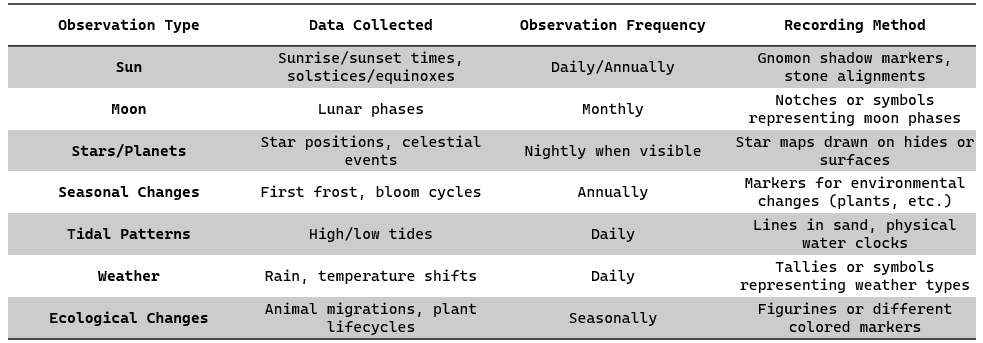
The Calendarians' process was labor-intensive and intergenerational, involving continuous observation, communal validation, and incremental refinement. By recognizing and responding to variability in celestial and environmental patterns, they developed a reliable calendar system that improved over decades. Today, only fragments of their work remain in a few museums across European capitals, yet the scientific community remains forever in their debt.
Modern AI-Driven Calendar Development
Several centuries after the last Calenderian finished her calendar-building effort, in a modern-day technology company a group of data scientists started designing an AI system to repeat the processes once performed by ancient civilizations to observe and predict celestial events hoping that modern AI systems, which would enhance and augment these efforts with remarkable speed, precision, and scalability. Where early humans spent decades meticulously tracking the movements of the moon, the sun, and the changing seasons, today’s AI systems rely on sophisticated sensors and algorithms. They could potentially autonomously analyze vast quantities of data. The hope is that these systems can not only replicate the ancient methods of calendar creation but also surpass them in efficiency, performing in mere years what took human societies generations to refine.
To replicate the observational methods of early civilizations, an AI system designed for calendar development would be equipped with an array of sensors, much like how humans used their senses to observe their environment. These include light sensors to detect day and night cycles, temperature sensors to record daily and seasonal climate changes, humidity sensors to track moisture levels and seasonal shifts, cameras to capture the phases of the moon and track celestial patterns, and position sensors to follow the movements of celestial objects. This suite of instruments continuously gathers real-time data, collecting and processing information far more quickly and accurately than ancient human observers ever could.
However, in an effort to mimic the experience of early humans, the AI system would not begin with any pre-programmed knowledge of celestial cycles or modern calendar systems. Instead, the system would start with raw environmental data, much like the Calendarians first encountered the world without any pre-existing framework for understanding time. The AI would then learn to identify patterns through a process of gradual discovery and refinement.
The AI learning process would parallel the one used by ancient humans. Self-supervised learning (SSL) would allow the system to analyze raw, unlabeled data. Just as early humans noticed the rhythmic shifts in light between day and night, or the temperature changes between seasons, the AI would detect these fluctuations autonomously. Over time, it would recognize recurring patterns, such as the phases of the moon, based on repeated visual data, much like the Calendarians developed a basic understanding of lunar cycles.
To refine its knowledge further, the AI would use reinforcement learning (RL), a technique that more or less replicates the human trial-and-error process. The system would predict upcoming celestial events, such as the next full moon or the arrival of the solstice, and receive rewards for accurate predictions, while incorrect predictions would result in penalties. These feedback mechanisms would allow the AI to adjust its models over time, learning more efficiently with each iteration, much like ancient societies gradually improved their calendars based on accumulated observations and community feedback.
Recognizing that early humans had cognitive and technological limitations, the AI system would be designed to simulate these constraints. Its memory and computational power would be intentionally limited, forcing it to prioritize critical data while disregarding less relevant information. This reflects how ancient civilizations, lacking modern tools, focused on the most important patterns in their environment, such as when to plant crops or predict the tides. For instance, the AI might use fuzzy logic to classify temperatures into broad categories like "cold," "warm," or "hot," rather than relying on precise numerical data. This approach mirrors how ancient humans would have qualitatively assessed weather and seasonal changes using rudimentary tools and their senses.
The AI would also need to manage complex, long-term dependencies in the data, such as recurring lunar cycles or seasonal shifts. To accomplish this, advanced algorithms like Long Short-Term Memory (LSTM) or Gated Recurrent Units (GRU) would be used. These models allow the AI to track time-series data, recognize long-term trends, and make predictions about future events—just as ancient human societies did with their cyclical understanding of the moon and sun.
In much the same way that ancient humans balanced multiple priorities such as tracking the lunar phases for religious festivals, and timing agricultural activities based on the solar year, the AI system would need to handle multi-objective optimization. It would have to accurately predict a variety of key events, such as solar equinoxes and solstices, lunar phases, and seasonal transitions. These objectives would be weighted in its learning process, ensuring that the AI could balance the need for agricultural planning, societal scheduling, and the understanding of long-term celestial cycles. By using both historical and real-time data, the AI would continuously improve its predictive accuracy with minimal human intervention.
An important aspect of the AI system's development would be hyperparameter tuning (adjusting the variables that control the learning process to ensure optimal performance). Factors like the learning rate in reinforcement learning would determine how quickly the system adapts to new information, while parameters such as the discount factor would influence how the AI balances short-term and long-term objectives. Early human societies also adjusted their understanding through trial and error, refining their calendars over decades; similarly, hyperparameter tuning ensures that the AI remains adaptable, exploring new patterns while leveraging known information to make more reliable predictions.
Where the Calendarians took many decades to develop their calendar systems, modern AI has the potential to achieve similar results in just a few years. The first year would be spent gathering and analyzing basic data, much like early humans who began by observing the sun and moon. By the second and third years, the AI would refine its models through iterative learning and data accumulation, much as early societies gradually improved their predictions through repeated observations. By years four through six, the AI would have fine-tuned its predictions, deploying an accurate, autonomous calendar system capable of predicting celestial and seasonal events with minimal need for further human oversight.
Through such processes, AI has the potential to replicate the methods of ancient civilizations, or even further exceed them in speed, precision, and scalability. It could construct a highly accurate calendar system based purely on the environmental data it observed, offering a powerful demonstration of how modern technology can build upon the foundations of human innovation to achieve even greater accuracy and understanding in the domain of timekeeping.
Implications for Modern AI
The exploration of ancient human efforts to develop calendar systems, whether in a world with a single moon or hypothetical scenarios involving two or five moons, reveals the extraordinary capacity of human creativity and cognition in the face of complexity. In the two-moon and five-moon worlds, early humans would have been pushed to the limits of their cognitive and observational abilities, dealing with multiple interacting cycles that would have demanded entirely new ways of thinking and recording information. Faced with the challenge of distinguishing between overlapping celestial influences, they would have had to invent sophisticated methods of data collection, sharing, and prediction to make sense of their environment.
Yet, despite these challenges, it is likely that early humans would have succeeded in creating systems that accounted for the complexities introduced by multiple moons. Their resilience and ability to innovate, driven by necessity, would have helped them to develop new frameworks of understanding, exceeding the simpler binary thinking associated with just the moon and the sun. Is it fair to say that our innovative processes are heavily influenced, in their inception, by our ancestors’ observations of a single moon and the sun? The complex mental models they built have acted as the groundwork for more advanced structured systems capable of creating more complex mathematical models by future scientists.
We are now building AI systems that can replicate and exceed many human efforts in many domains. AI, with its ability to process massive amounts of data, can quickly uncover patterns and generate models of environmental phenomena and industrial systems. One question is how much we can push AI beyond our own ingrained biases and simplified models of thinking. In training AI models, we must avoid embedding oversimplified, binary views of the world which is common in many human-like reasoning systems, which can limit their ability to handle more nuanced, real-world scenarios. Just as the hypothetical five-moon system would have forced early humans to develop more sophisticated models of celestial movements, we must design AI that can tackle multi-layered, complex problems. This means moving beyond traditional, straightforward approaches and specifically beyond training AI models to maximize financial profit margins. By designing AI systems capable of handling the equivalent of a five-moon environment we can hope that our models are free from human biases and better equipped to handle future challenges.